
BioEden Biomes and Hex Domes
Five Bestiary tabs, named sites such as Red Forest, and a knowledge tree per biome.
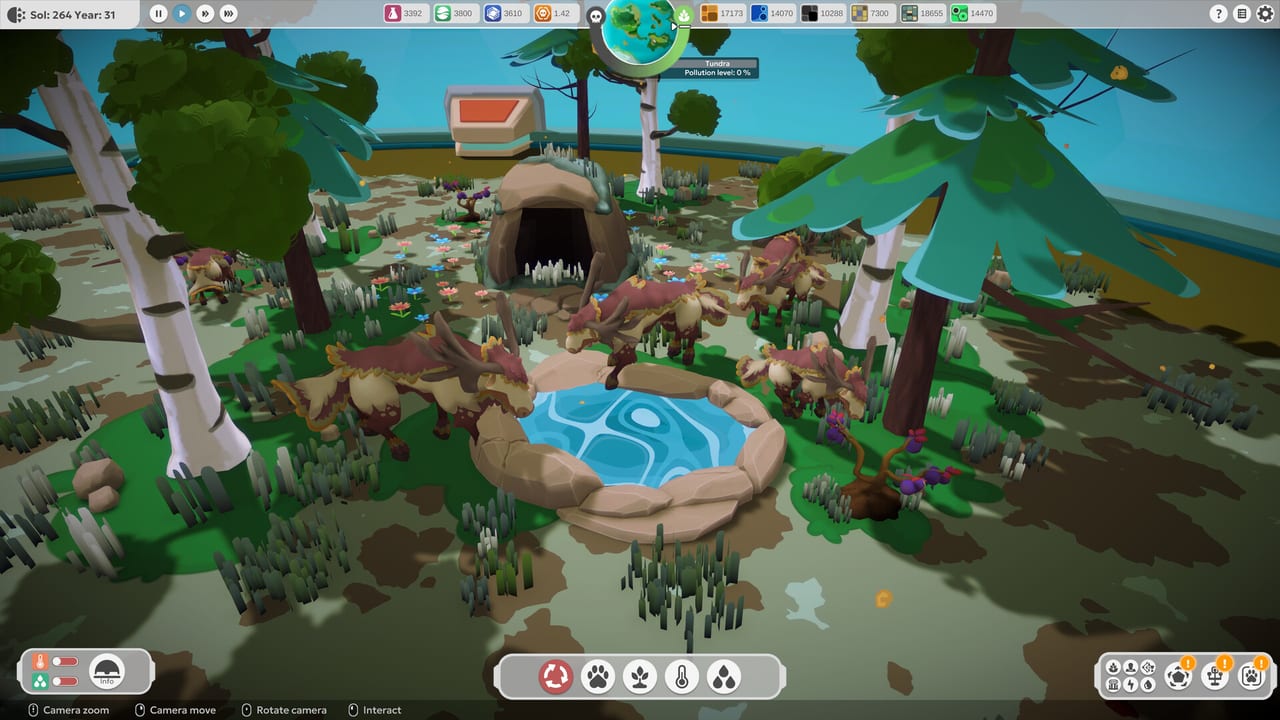
BioEden’s outside map is a hex grid of wounded land. The inside of each dome is a climate you choose, not a wallpaper. The Bestiary — that is the UI name — splits creatures into Forest, Jungle, Prairie, Savannah, and Tundra tabs. Named sites such as Red Forest sit on the globe as restoration problems with their own pollution slice. If you clone one Forest greenhouse across every hex, you will spend the rest of the session fighting humidity, DNA unlocks, and a Prairie that never cools.
The playable Steam demo leans on Forest and Jungle animal tracks while still letting you see the other tabs. Prairie and Tundra can look thin. That is the tutorial, not the whole 15–20 hour game scheduled for 3 September 2026. Use this page to place the next dome. Hatch details live in animal care. Fragment lists live on the DNA / Bestiary page. First contact with Charles is still Getting Started.
Forest, Jungle, Prairie, Savannah, Tundra, Red Forest
Forest is the gentle start. Native plants such as Fern show up early. Landowl’s window — roughly 20–45° and 55–90% humidity — is a Forest-adjacent comfort zone the demo is happy to teach. Keep the dome on a hex that already wants that air. Jungle is wetter, louder, and where names like Slink, Ributs, Basker, Fimble, Thudder, and Mirra start filling the tab. Each card still has its own DNA cost and its own plant. Do not assume Jungle humidity is “more Forest.”
Prairie is the trap biome in a lot of demo sessions. It looks open, so Keepers stamp extractors, radar, and a second solar field, then watch the globe read 95%. Prairie is not empty; it is a site that records footprint clearly. Restore it with recycle and lake purification, not with a cloned Jungle humidifier farm. Savannah runs hotter and drier. Tundra runs the other way. A Tundra card in a Savannah hex is legal and expensive: more climate tools, more energy, more impact. Put the dome on native ground when the hex grid gives you a choice.
Red Forest is a named site, not a sixth Bestiary tab. It can sit at 65% pollution while a nearby Jungle reads 8%. Treat that number as a restoration job from restore the planet. Reclaim ruins, purify water, recycle idle industry. Animals come after the hex can breathe. The Cosmic Collective still wants both: a living dome and a globe that is not a skull.
Hex placement is the decision. Walk the grid before you confirm a dome ghost. Look at debris, lakes, and the globe slice for that hex. A pretty ridge with no water and a high pollution tag is a vanity build. Place the dome, draw the shortest pipe and cable from power and water, then install only the climate tools the next card requires.
Do not clone one climate
Keepers clone because the first dome worked. Landowl is happy, Fern is down, the incubator stages completed, and the palette is still open. A second dome with the same temperature tools on a Prairie hex will fight the hex. You will dump energy into humidifiers, then wonder why Impact Level climbed while DNA in the Prairie tab stayed locked.
DNA and plants unlock per biome through the knowledge tree. Let’s Plays show a research building that earns research points once it is powered. Those points advance the biome you are actually studying. Jungle points do not finish the Tundra tree. If you want a Tundra plant, you need Tundra research, Tundra DNA, and a dome that can hold Tundra air. Grinding Forest because it feels safe only makes a Forest zoo.
Collective Requests will sometimes ignore this and ask for industry on the wrong hex. Active Regulations may punish that industry. Delay the request. Recycle the extra buildings. BioEden has no fail states; a missed factory quota is not a lost planet. The demo guide is full of tutorial Keepers who learned this after the globe turned red.
Predator-prey rules do not change by tab. A carnivore next to a herbivore can still eat the herbivore. Separate them in every biome. Rankings of which cards are easy to house sit on the animals tier list. Darwin as a full-game guild will care more about this biology than Euler will; the demo’s training path will not. Preview guilds in the guild picker after you can place two different climates without copying the first.
Knowledge tree, radar, and when to leave a hex
Radar opens fog so you can see the next biome hex. It also costs footprint. Place it to reveal a lake or a debris field you need, then recycle it if the fog is already gone. Research buildings stay as long as the tree is feeding you plants and DNA you will house this session. When the tab you care about is unlocked, power them down or recycle. Idle science is still an Orb Factory’s cousin: draw without a quota.
The Great Unraveling is the mystery the full game wants you to wander toward. Guilds disagree on its cause. The demo only hints. Do not skip biome variety in the tutorial just because the story is thin here; the habit of one-climate sprawl is what you would carry into the 3 September 2026 release on Steam, PlayStation 5, Xbox Series, and Nintendo Switch 2.
When a hex is stable — low pollution, one matching dome, one matching species — leave it. Restore soil, purify the lake, pick up the camera, and walk. Charles will still offer chores. You do not have to build on every tile he likes. The controls page is there if the globe widget is hiding in a zoom. The review is honest about how fussy matching five climates can feel, and about how the loop is supposed to be 15–20 hours of that fuss without a fail state.
A planet of five weathers is the point. Place each dome on the hex that already wants that air, grow the knowledge tree for that tab, and refuse to photocopy the first greenhouse.
Frequently Asked Questions
Quick answers to the most common questions.
What biomes are in BioEden?
The Bestiary tabs are Forest, Jungle, Prairie, Savannah, and Tundra. Red Forest is a named site on the globe. Care per species sits in animal care.
Should I use the same climate in every dome?
No. Cloning one climate fights the hex and stalls other DNA tabs. Place domes on native ground and wire them with power and water.
How do I unlock plants and DNA for a new biome?
Research points feed a biome knowledge tree. Jungle points do not finish Tundra. Fragment lists are on the DNA / Bestiary page.
Why is my Prairie at 95% pollution?
Overbuilding. Recycle unused extractors and factories, purify the lake, and stop cloning extra domes. Follow restore the planet.
Does the Steam demo include every biome?
You will play Forest and Jungle tracks and see the other tabs; some are thin. The tutorial is not the full game. Scope is in the demo guide.